

24/7/365
If you’ve tried to cut back or stop drinking and found it harder than expected, you’re not alone—and you’re not out of options.
Alcohol addiction is treatable. With the right combination of medical support, therapy, and structure, long-term recovery is possible.
At Recovery 180 MD, we provide personalized, structured alcohol addiction treatment, with a focus on residential care (ASAM 3.1), for individuals across Maryland.
Call now to speak with our team or verify your insurance in minutes.
If you or a loved one needs support, you don’t have to wait.
Call now or request a confidential callback.
Alcohol Use Disorder (AUD) is a medical condition where drinking begins to impact your health, relationships, or ability to function.
It exists on a spectrum—from mild to severe—and doesn’t always look the way people expect.
You don’t have to “hit rock bottom” to benefit from treatment. Many people seek help earlier—and see better outcomes because of it.
You may benefit from treatment if you’ve experienced:
Recognizing these signs early can make treatment more effective and recovery more manageable.
One of the biggest barriers to stopping alcohol use is withdrawal.
Symptoms can range from mild to severe and may include:
For some individuals, medical detox is necessary to safely manage withdrawal symptoms.
If you’re unsure whether you need detox, our team can help you understand your risk and guide you to the appropriate level of care.
Learn more about alcohol withdrawal symptoms and detox options before starting treatment.
Effective treatment combines medical care, therapy, and structured support.
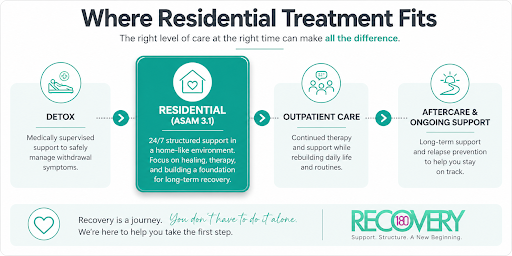
Alcohol addiction treatment is structured in levels of care based on your needs.
These may include:
While each level serves a purpose, many individuals benefit most from structured, supportive environments that provide consistency and accountability early in recovery.
At Recovery 180 MD, we specialize in Residential Treatment (ASAM 3.1)—a structured level of care designed to help individuals stabilize, build routines, and develop the foundation for long-term recovery.
Residential treatment (ASAM Level 3.1) provides 24-hour support in a structured, live-in environment without the intensity of hospital-based care.
This level of care is ideal for individuals who:
In this setting, treatment focuses on:
Not everyone needs the same level of care.
Residential treatment (ASAM 3.1) may be the right fit if:
For individuals who need more flexibility, outpatient options may be appropriate—but for many, starting with a structured residential program leads to stronger, more sustainable outcomes.
Treatment isn’t just about stopping alcohol use—it’s about understanding and changing patterns.
Our approach may include:
These therapies help you build coping skills, manage triggers, and create long-term stability.
Medication can be an effective part of alcohol addiction treatment—especially when used alongside structured care and therapy.
At Recovery 180 MD, medication is not a standalone solution, but rather a tool that may be incorporated into a comprehensive treatment plan when clinically appropriate.
Common medications include:
These medications are most effective when combined with:
Within our Residential Treatment (ASAM 3.1) program, medication—when used—is carefully monitored and integrated into your overall recovery plan.
Learn more about how medication-assisted treatment (MAT) fits into structured care.
Starting treatment can feel overwhelming—but knowing what to expect helps.
Each step is designed to help you build stability, confidence, and long-term change.
At Recovery 180 MD, we focus on providing structured, effective care through our Residential Treatment (ASAM 3.1) program.
Our approach includes:
We don’t believe in one-size-fits-all care—we focus on helping you build a foundation that lasts.
Recovery doesn’t end when a program does.
Ongoing support may include:
This continued care helps you maintain progress and build a stable, fulfilling life.
Cost shouldn’t stop you from getting help.
We’ll help you:
Verify your insurance now—it takes less than 2 minutes.
There isn’t a quick cure, but alcohol addiction can be effectively treated and managed long-term.
If withdrawal symptoms are present, medical detox may be recommended before starting treatment.
It depends on your needs. Some individuals benefit from weeks of care, while others continue treatment over several months.
You don’t have to figure this out on your own. Talk with someone who understands what you’re going through.
Friendly Operators are Standing By