


You did not imagine this chapter.
And you did not fail because it’s happening.
When a 20-year-old who’s already had help starts using again, parents often describe the same feeling: a heavy, stunned grief. The kind that sits in your chest and whispers, “I don’t know how to help anymore.”
If you’re quietly wondering whether a more structured, live-in level of care is needed — and also feeling like that step is impossible — you’re not alone.
Many families begin by simply gathering information about options like live-in treatment at our Baltimore location. Even clicking that link can bring up fear. That’s normal. Big decisions feel bigger when your heart is involved.
Let’s walk through this slowly.
The Word “Residential” Feels Like a Cliff
For many parents, the phrase residential treatment program doesn’t sound like support.
It sounds like:
- Sending them away
- Losing daily contact
- Admitting this is “serious”
- Accepting that outpatient care wasn’t enough
It can feel like standing at the edge of a cliff. Once you say yes, there’s no going back.
But in reality, stepping into round-the-clock support isn’t a cliff. It’s a container.
It’s structure.
It’s safety.
It’s time carved out for stabilization.
The fear is about what it means. The care itself is about protection.
You’re Grieving the Future You Thought Was Starting
When your child first got help, you probably allowed yourself to breathe.
Maybe you pictured:
- School back on track
- Work stabilizing
- Fewer 2 a.m. texts
- Less tension at home
When substance use returns, it doesn’t just feel frightening. It feels like losing that hopeful version of the future all over again.
Parents often tell me, “We were doing better. I thought we were past this.”
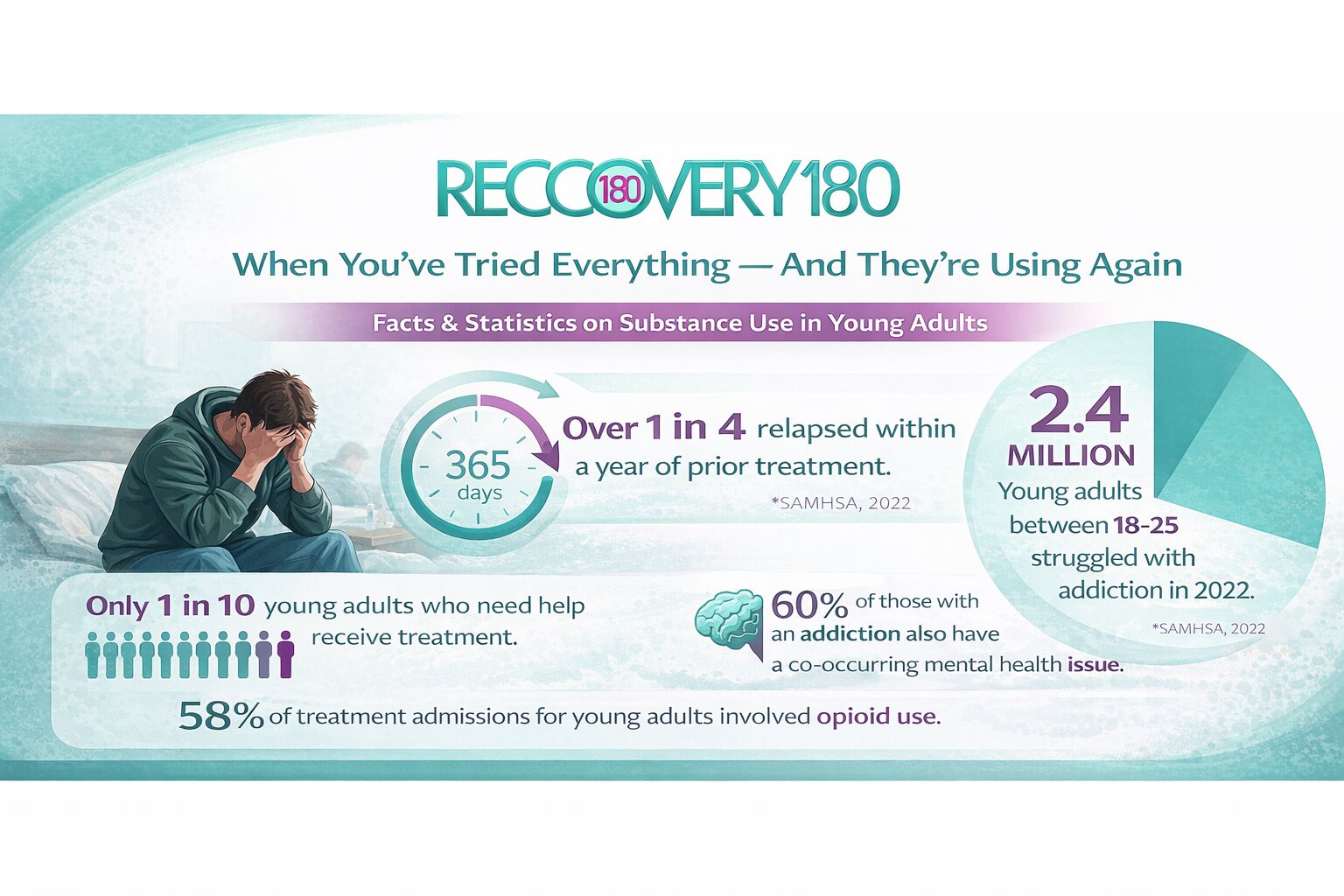
Relapse or continued use at 20 isn’t a rewind to zero. It’s a sign that something underneath still needs attention. Developmentally, young adults are still forming identity, coping skills, and emotional regulation. When substances are layered on top, the path gets complicated.
Grief makes everything feel urgent. But grief also deserves space.
When Mental Health and Substance Use Tangle Together
At this age, we often see anxiety, depression, trauma history, or mood instability intertwined with substance use.
What looks like defiance may be:
- Panic they can’t name
- Depression they can’t articulate
- Shame they can’t tolerate
- Fear of failure they’re trying to numb
When both mental health and substance use are present, weekly therapy or multi-day weekly treatment may not provide enough containment.
Sometimes a young adult needs:
- A break from environmental triggers
- Consistent daily therapy
- Medication stabilization if needed
- Peer accountability
- Protected space to reset sleep, nutrition, and routine
That level of structure can feel extreme from the outside. From a clinical perspective, it can be preventative.
“What If They Refuse?”
This is one of the hardest realities of parenting a 20-year-old.
They are legally adults. You can’t simply enroll them the way you did when they were 15.
But you are not powerless.
You can:
- Stop cushioning consequences that protect the behavior
- Clearly name what you’re observing
- Share your fears without attacking
- Ask them what feels out of control
- Present options instead of ultimatums
A conversation might sound like:
“I love you. I’m scared. What we’re doing right now isn’t working. I want us to look at something with more support.”
You’re not demanding surrender. You’re inviting reflection.
Sometimes resistance softens when parents shift from panic to steadiness.
The Guilt Is Loud — But It’s Not Accurate
Almost every parent I sit with asks some version of:
Did we miss something?
Were we too trusting?
Too strict?
Too distracted?
Addiction and co-occurring mental health challenges are complex. They are influenced by genetics, neurobiology, trauma exposure, social environment, and developmental factors.
They are not caused by loving parents who tried.
Your love is not what created this.
Your boundaries are not abandonment.
Your exhaustion is not weakness.
If anything, your willingness to consider stronger support reflects deep commitment.
Why This Step Can Feel Financially and Logistically Impossible
Let’s name another layer.
Parents worry about:
- Cost
- Insurance coverage
- Work disruptions
- Siblings at home
- What extended family will say
These are real stressors.
It can feel like one more burden stacked onto an already fragile situation.
The truth is, untreated substance use and mental health crises also carry long-term costs — emotionally, medically, legally, academically.
Gathering information doesn’t commit you. It equips you.
In Maryland, families often begin by simply exploring options for support in Baltimore, MD. A consultation can clarify insurance questions, timelines, and whether this level of care is even clinically indicated.
You deserve clarity before you decide.
What “More Structure” Actually Provides
From a clinician’s standpoint, stepping into a residential treatment program isn’t about punishment.
It’s about stabilization.
It offers:
- Daily individual therapy
- Group accountability
- Psychiatric oversight
- Consistent routine
- Distance from immediate triggers
- Family involvement
Think of it as scaffolding around a building that’s under repair. The scaffolding isn’t permanent. It’s there to support reconstruction.
For some young adults, that containment interrupts a dangerous trajectory early.
For others, it creates insight that outpatient care couldn’t access.
You’re Allowed to Be Tired
Parents often carry this silently:
“I don’t know how much longer I can do this.”
You love your child deeply. And you are tired.
Tired of monitoring.
Tired of wondering.
Tired of scanning their tone for clues.
Tired of checking bank accounts or pill bottles or social media.
Choosing more intensive support can also be an act of preserving the family system — including you.
You matter in this equation.
FAQ: Questions Parents Often Ask
How do I know if a higher level of care is actually necessary?
Signs that additional structure may be needed include:
- Continued substance use despite prior treatment
- Escalating mental health symptoms
- Unsafe behaviors
- Inability to maintain work or school
- Frequent crises at home
An assessment with a licensed clinician can clarify whether live-in care is appropriate or if adjustments to outpatient support might suffice.
Will this damage our relationship?
Parents fear this deeply. In most cases, when the decision is communicated with love and clarity — not punishment — relationships stabilize over time. Boundaries may feel uncomfortable in the short term, but safety builds trust long term. Young adults often express gratitude later for interventions that felt frustrating at the time.
How long does this level of care last?
Length of stay varies depending on clinical needs, progress, and safety considerations. It is not indefinite. Treatment plans are individualized and reviewed regularly. The goal is stabilization and skill-building — not permanence.
What if they leave early?
Because they are adults, voluntary programs require their participation. That’s why motivational work and collaborative conversations are critical before admission. Even if a young adult leaves early, the experience can still provide insight that shapes next steps. Nothing is wasted.
Are families involved?
Yes. Effective programs include family therapy, education, and communication planning. Substance use and mental health struggles affect the entire system. Healing often works best when families are supported alongside their loved one.
What if I’m not ready to commit to this yet?
That’s okay.
You can start with:
- A consultation
- A clinical assessment
- A conversation with your child’s current therapist
- Education about levels of care
Information does not equal commitment. It equals preparation.
You Don’t Have to Decide Tonight
When your nervous system is flooded, everything feels urgent.
But the next right step is usually small.
A phone call.
A consultation.
A question answered.
If you’re in Maryland and trying to determine whether this level of care makes sense for your family, you can start by learning about options for structured, live-in support through our Baltimore location.
Call 410-584-3155 or visit our residential treatment program services in Baltimore to learn more about our residential treatment program services in Baltimore.
You are not overreacting for considering this.
You are not weak.
You are a parent standing in a hard place, trying to protect your child while they’re still reachable. That kind of love is not impossible. It’s powerful.