

24/7/365
If you’re looking for addiction treatment in Maryland and you’re covered by Medicaid, one of the first questions you need answered is whether a facility will actually accept your plan. We do. Recovery 180 accepts all forms of Maryland Medicaid for our residential addiction treatment program – and our admissions team can walk you through exactly what that covers before you make any decisions.
This page explains what Maryland Medicaid typically covers for addiction treatment, how Recovery 180’s program fits that coverage, and how to verify your specific plan in a single phone call.
Yes – Maryland Medicaid covers addiction treatment as a behavioral health benefit under the federal Mental Health Parity and Addiction Equity Act. That means substance use disorder treatment, including residential care, is covered at the same level as other medical conditions.
In Maryland, Medicaid behavioral health services are managed through the Maryland Behavioral Health Administration (BHA), and coverage is delivered through Medicaid Managed Care Organizations (MCOs). Most Maryland Medicaid enrollees are in one of these managed care plans. The specific benefits available to you – including which level of care is covered and for how long – depend on your individual plan and clinical need.
Maryland Medicaid often covers:
Coverage for residential treatment is typically authorized based on a clinical assessment – your level of need has to match the level of care being requested. Our admissions team handles that process and works directly with your plan to get an authorization in place before you arrive.
Recovery 180 is a licensed ASAM 3.1 low-intensity residential treatment provider. ASAM 3.1 is the specific level of care designed for people who need a stable, structured living environment and ongoing recovery support – but who don’t require the 24-hour medical monitoring of a hospital or high-intensity residential setting.
For clients whose Maryland Medicaid plan covers this level of care, Recovery 180’s program typically includes:
We accept all forms of Maryland Medicaid. If you’re unsure which MCO you’re enrolled in or whether your specific plan covers residential treatment, our admissions team will look that up for you – you don’t need to figure that out on your own before calling.
Maryland Medicaid (HealthChoice) is available to Maryland residents who meet income and eligibility requirements set by the state. Generally, adults who earn up to 138% of the federal poverty level are eligible, though specific rules vary by category.
Common categories include:
If you’re already enrolled in Maryland Medicaid, you don’t need to re-apply to access treatment. If you think you might be eligible but haven’t enrolled, Maryland’s Medicaid enrollment is available through the Maryland Health Connection at marylandhealthconnection.gov – and our team can point you toward resources if you need help with that process.
Eligibility for treatment at Recovery 180 specifically also involves a clinical screening to determine whether ASAM 3.1 residential care is the right level of care for your situation. That screening is part of the standard intake process and doesn’t cost anything.
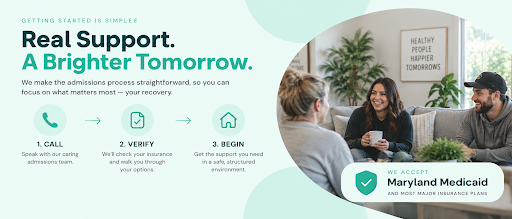
The simplest way to know what your plan covers is to call us directly: (410) 584-3155. Our admissions team runs insurance verifications as part of every intake conversation – we contact your Medicaid MCO, confirm your eligibility and benefits, and give you a clear picture of what’s covered before you make any commitments.
You can also submit your information through our insurance verification form, and we’ll reach back out with your coverage details.
What to have ready when you call:
If you don’t have your card or aren’t sure which plan you’re in, that’s okay – we can often look it up with just your name and date of birth. Verifying your coverage doesn’t start a treatment process or commit you to anything. It just answers the financial question so you can make an informed decision.
Recovery 180’s ASAM 3.1 residential program is built around structure, stability, and real-world preparation. Most clients come to us after completing a higher level of care – a detox, inpatient, or partial hospitalization program – and need a supported environment to continue building the skills and routines that make recovery stick.
A typical day includes scheduled group sessions, individual counseling, peer accountability time, and practical life-skills work. There are no bunk beds, no overcrowded houses – we cap each residence at four people, with a 3:1 staff-to-client ratio. Locations across Maryland mean we can often place you close to your home community or family support system.
Our clients generally stay for several weeks to a few months, depending on individual clinical needs and plan authorizations. Discharge planning starts early – we don’t wait until the last week to start thinking about what comes next. The goal is a transition that holds, not just a clean exit date.
Maryland Medicaid often covers medically supervised detoxification services when they are clinically indicated. Detox is typically considered a separate level of care from residential treatment – it’s the medical management of withdrawal, not the treatment of the underlying addiction itself. If detox is part of your situation, our team can help clarify what your plan covers and connect you with appropriate detox resources before or alongside admission to Recovery 180.
Maryland Medicaid covers multiple levels of residential and inpatient addiction treatment, including high-intensity residential (ASAM 3.7), low-intensity residential (ASAM 3.1), and partial hospitalization. Coverage for each level depends on clinical need and authorization from your managed care plan. Recovery 180 provides ASAM 3.1 – the level designed for people who need structure and support but not 24-hour medical monitoring.
Yes. Residential substance use treatment is a covered behavioral health benefit under Maryland Medicaid. Authorization is based on a clinical assessment of your level of need. Recovery 180 accepts Maryland Medicaid for our ASAM 3.1 residential program – we handle the authorization process with your plan as part of our standard intake.
Yes. Maryland Medicaid covers treatment for alcohol use disorder at the same level as other medical conditions, under mental health parity law. That includes residential programs, outpatient services, and medication-assisted treatment options relevant to alcohol use disorder. Recovery 180 provides residential treatment for both alcohol and drug addiction to clients covered by Maryland Medicaid.
The length of covered treatment varies by individual plan and clinical need. Maryland Medicaid does not set a fixed number of days for residential treatment – authorizations are based on ongoing clinical review. In practice, many clients receive initial authorizations of several weeks, with the option to request extensions based on clinical progress. Our team handles the authorization and renewal process and keeps you informed of where things stand.
If you’ve applied for Maryland Medicaid but haven’t received a decision yet, call us anyway. Pending Medicaid can sometimes be verified in advance, and there may be other options to explore in the interim. Our admissions team navigates these situations regularly and can advise on next steps specific to your circumstances.
No referral is required to call and start the intake process. You can contact us directly. Referrals from hospitals, courts, social workers, or other treatment providers are welcome, but they’re not a requirement for admission.
Calling doesn’t start a clock. It doesn’t commit you to anything. It’s a conversation – usually 10 to 15 minutes – where we look up your Medicaid benefits and tell you exactly what’s available to you at Recovery 180.
Our admissions line is available 24 hours a day, seven days a week: (410) 584-3155
Or submit your insurance information online and we’ll call you back with your coverage details. Either way, you’ll have a clear answer – and that’s usually the first thing people need before they can move forward.
Friendly Operators are Standing By